
On this page
- Why do gutters overflow?
- How much more does a 6-inch gutter carry?
- Which Richmond houses benefit?
- Richmond rain and gutter size
- How is a 6-inch system installed?
- Valleys
- Downspouts matter as much as the gutter
- Cost factors
- How do you tell if a gutter is undersized?
- Mixing sizes on one house
- Outlets and elbows
Why do gutters overflow?
Overflow has four causes, and only one of them is size.
| Cause | Sign | Fix |
|---|---|---|
| Clogged outlet or downspout | Water stands in the trough, overflows near the outlet | Clean and flush; consider guards |
| Flat or reversed pitch | Water stands mid-run | Re-hang to the correct fall |
| Too few outlets | Overflow at the far end of a long run | Add a downspout |
| Gutter too small | Overflow in heavy rain even when clean | 6-inch gutter, 3x4 downspouts |
Rule out the first three before paying for bigger gutters.
How much more does a 6-inch gutter carry?
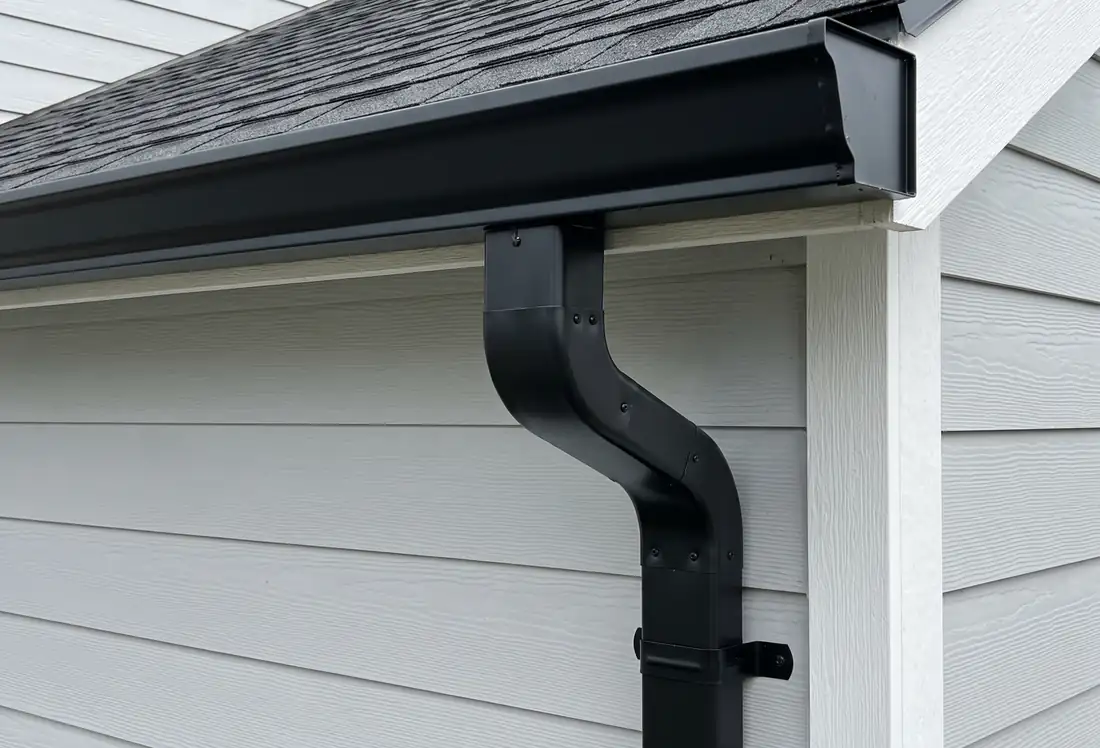
A 6-inch K-style gutter has a deeper and wider trough than a 5-inch one, and it is paired with larger outlets and 3x4 downspouts. The combination moves considerably more water, and the bigger outlets clog less readily.
| Spec | 5-inch K-style | 6-inch K-style |
|---|---|---|
| Top width | About 5 inches | About 6 inches |
| Usual downspout | 2x3 inch | 3x4 inch |
| Downspout area | 6 square inches | 12 square inches |
| Best suited to | One-story and modest roofs | Steep, large and two-story roofs |
| Look | Standard | Fuller on deep fascia |
Which Richmond houses benefit?
- Two-story colonials in Short Pump, Glen Allen, Mechanicsville and Midlothian, where the main roof sheds a large plane onto one long rear gutter.
- Hip roofs with valleys, where two planes meet and pour into a few feet of gutter.
- Steep roofs on Tudor and Colonial Revival houses in Westover Hills and Forest Hill. Water moves faster on a steep slope and overshoots a small gutter.
- Long runs with one downspout, common on builder-grade houses.
Richmond rain and gutter size
Richmond's 1991 to 2020 normal is about 45.5 inches of precipitation a year, spread through every season. Summer thunderstorms and tropical remnants are what test a gutter. On the NWS list of the city's wettest 24-hour totals, Connie in 1955 and Gaston in 2004 top the table at 8.79 and 6.68 inches. Gutters sized for a strong thunderstorm overflow far less often in the ordinary heavy rains that come several times a year.
How is a 6-inch system installed?
- Confirm the cause of overflow with a water test or by watching a storm.
- Measure the runs and decide which need 6-inch; often only the back or the runs below valleys.
- Check the fascia: a 6-inch gutter needs at least the same depth of sound wood behind it.
- Form the gutters on site from .027 or .032-inch aluminum.
- Cut 3x4 outlets and add outlets near valleys.
- Hang on hidden hangers at 24 inches or closer, with the pitch toward each outlet.
- Fit 3x4 downspouts with extensions that carry water well clear of the foundation.
- Water-test each run.
Valleys
A valley is where two roof slopes meet and channel water into a narrow stream. In heavy rain that stream can overshoot the gutter entirely. Fixes include a 6-inch gutter, a valley splash guard (a small metal diverter on the gutter's front lip), and an outlet placed just past the valley so water has the shortest path out.
Downspouts matter as much as the gutter
A 6-inch gutter emptying into a 2x3 downspout is a bottleneck. Ask for 3x4 downspouts, and for each one to discharge at least several feet from the foundation. On Piedmont clay, a bigger gutter dumping more water at the corner of the house makes a wet basement worse. See downspouts and downspouts and drainage in Richmond.
Cost factors
- Which runs go to 6-inch
- Coil thickness
- Number of 3x4 downspouts and their length
- Extensions or underground drains
- Fascia repair
See 5-inch vs 6-inch gutters for a fuller comparison.
How do you tell if a gutter is undersized?
Watch it in a hard rain after it has been cleaned. If water stands in the trough and pours over the front near the middle of a run, or sheets over the outside corner where a valley empties, the gutter or its outlets are not keeping up. If water only overflows near the outlet, the downspout or its elbows are the problem. If the gutter overflows only in spots, check the pitch at those spots before changing size.
Mixing sizes on one house
Many Richmond-area houses do not need 6-inch all the way round. A common plan is 6-inch on the long rear run of a two-story house and on any run below a valley, with 5-inch on short front runs, garages and porches. Profiles match, so the change is hard to spot from the street, and the cost stays lower than a full 6-inch system.
| Run | Usual size |
|---|---|
| Long rear run, two-story | 6-inch |
| Below a valley | 6-inch, with an outlet near the valley |
| Front runs on a two-story | 5 or 6-inch to match |
| Garage, porch, dormer | 5-inch |
Outlets and elbows
The jump from a 2x3 to a 3x4 downspout doubles the opening and makes gumballs, seeds and leaves far less likely to jam in an elbow. On houses under sweetgums and oaks, that alone cuts overflow, even before the gutter changes.